Supervised by Andreas Hamann (University of Alberta), Christoffel de Lange (Transfrontier Africa) and Marine Servonnat (Ingwe Research Program).
Short term goal: To understand whether pre-existing road culverts can serve as cost-effective wildlife underpasses.
Long term goal: To create safe crossing corridors for wildlife species by improving culverts design (i.e. low erected fences)
Abstract:
Submitted as part of the Savanna Science Network Meeting in March 2025.
Roads pose a substantial threat to wildlife species by creating a barrier to dispersal, fragmenting habitats, and causing wildlife-vehicle collisions. A potential mitigation measure is to encourage wildlife use of pre-existing culverts (i.e., pipes underneath roads designed for water drainage) as safe underpasses. However, their effectiveness remains poorly understood and likely depends on culvert design, location, and surrounding environmental factors. A section of the R40 provincial road in South Africa, runs through a network of protected and unprotected areas and has experienced an increase in wildlife-vehicle collisions due to rising traffic volumes, directly affecting species of high conservation and touristic value. To address this, our study aims to assess the potential of using culverts for safe wildlife crossings along the highway by (1) quantifying current wildlife use of culverts and (2) identifying which characteristics most influence their use. To do this, we placed camera traps at 56 culverts along a 47 km stretch of the R40 and tested how rates of use varied between species and with culvert characteristics.
Preliminary findings from the dry season revealed that species from various taxa frequently used the culverts. Although, rates of use varied widely among taxa, sites, and culvert characteristics. While wet season sampling is still underway, these findings suggest that culverts could be crucial for safe wildlife crossings. Ultimately, the results from our study will help guide future culvert design, placement, and management, and will contribute to broader efforts to maintain landscape connectivity and wildlife movement across human-modified landscapes.
See below the presentation by Tanis Short at the Savanna Science Network Meeting. The 10-minute presentation starts at 5h02.
Methodology:
Camera Trap Monitoring To evaluate how wildlife utilizes existing infrastructure, we monitor 56 culverts of the 119 culverts along a 47km stretch of the R40 in Hoedspruit.
Sampling Effort: The study area is divided into two sections, with camera traps deployed for a 45-day duration in each section.
Seasonal Variation: Monitoring is conducted during both the dry and wet seasons to capture seasonal shifts in movement and behavior.
Protocol: Motion-activated cameras (Bushnell Core S-4K No-Glow Trail Camera) are placed at culvert entrances to provide a 24/7 record of wildlife crossing attempts and successes.
Physical Variables: We record 13 attributes for each culvert that may influence animal choice, including size, the "openness" index, and entrance-specific traits such as elevation and shape.
The methodology and fieldwork design for our road ecology project were developed with the expert support of Dr. Wendy Collinson, Dr. Thabo Hlatshwayo and Dr Clara Grilo. Their guidance was instrumental in establishing the project’s scientific foundation and conceptual framework.
Preliminary Results
Dry Season Data Highlights
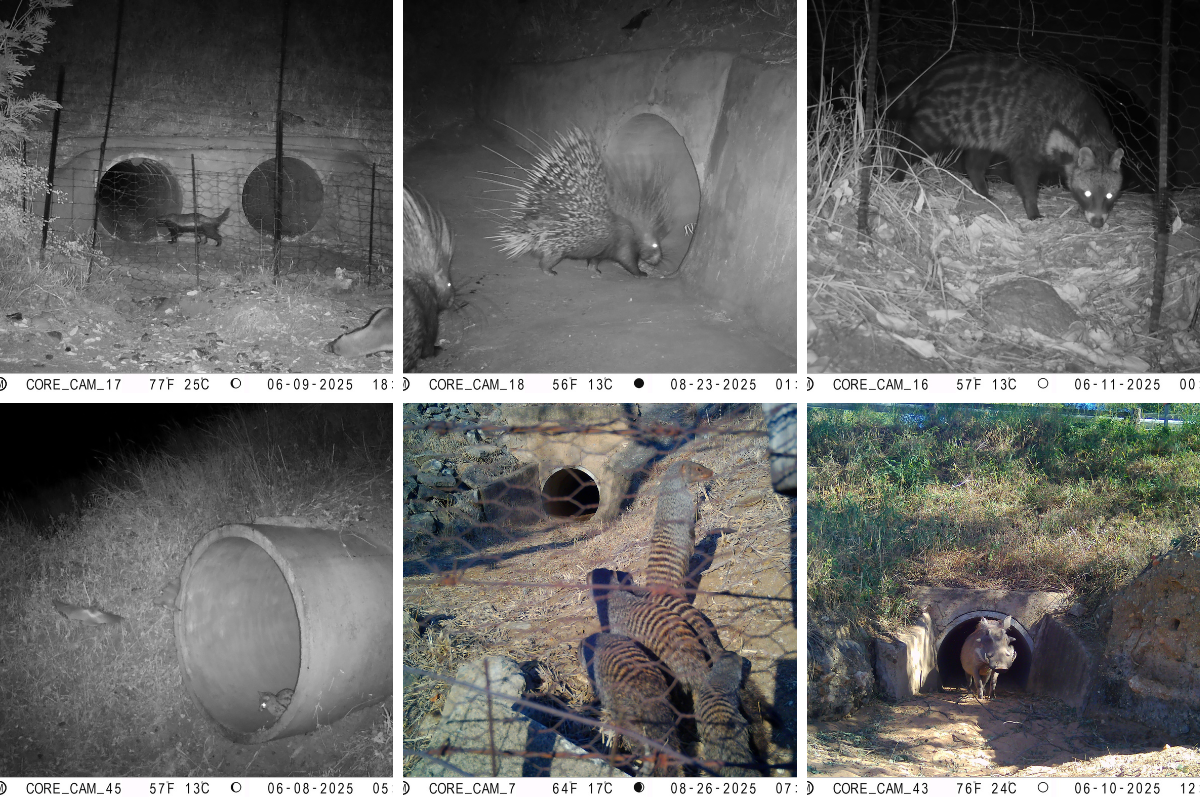
During the 2025 dry season survey, we recorded 960 total crossing events involving 17 different species.
Concentrated Use: While activity was spread across the study area, 9 culverts accounted for more than 50% of all crossings. The most active single culvert handled 13% of all traffic.
Inactive Sites: 7 culverts saw no wildlife activity during this period.
Leopard Activity: We recorded 141 leopard "captures" on camera. Of these, leopards successfully used the culverts 55% of the time, resulting in a weekly average of 9.7 crossings.
The R40 Leopard Population
Through individual coat pattern identification, we also recorded several other leopards, including:
Females: Bokamoso, Black Dot, Rhulani, and the Lion Pan female.
Males: Corkwood, Nigel, Medupi, and Mafu.
Key Observation: Currently, the leopard is the only large predator recorded using these culverts, highlighting their unique adaptability compared to other apex predators in the region.
Species Diversity Under the R40
A wide variety of mammals and reptiles were documented using the underpasses. The species with the highest crossing frequencies included:
Occasional Users: Dwarf Mongoose, African Wild Cat, Water Monitor, Squirrel, and Mouse.
Rare Sightings: Only one instance of a Hyena crossing was recorded.
Looking Ahead: 2026 Wet Season
Following the conclusion of the dry season, the next phase of the study was scheduled for early 2026. Due to major flooding in January, the Wet Season Survey was rescheduled to run from February to April 2026. This upcoming period will be critical in determining how increased water levels and seasonal vegetation changes impact wildlife movement patterns.
About this Project
Partners & Sponsors
Join Us in Conservation Efforts
Make a donation and help protect leopards and their habitats in South Africa.