By: Eleanor Salisbury (Nottingham Trent University). Research project submitted in partial fulfilment of the MRes. Endangered Species Recovery and Conservation degree.
Supervised by: Charlotte James (Nottingham Trent University), Dr. Andrea Marais-Potgieter (University of Witwatersrand), Paul Allin (Transfrontier Africa) & Marine Servonnat (Ingwe Research Program).
Short term goal: Exploring societal perceptions towards leopards and human-leopard coexistence in wildlife estates in South Africa.
Long term goal: To highlight several implications for wildlife estate management to support human-leopard coexistence.
Abstract:
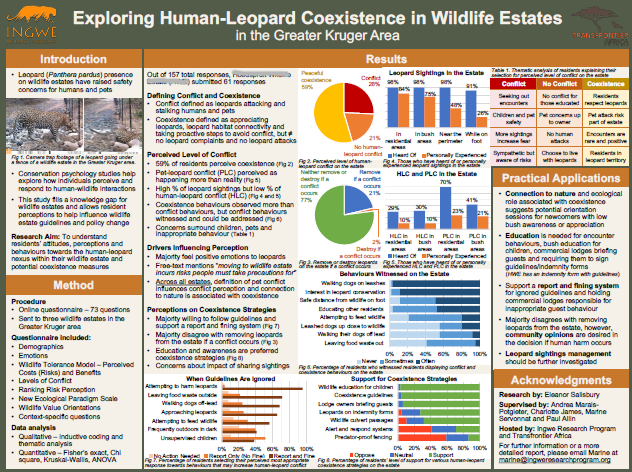
Wildlife estates in South Africa combine residential living with the opportunity to live close to nature among free-roaming wildlife, including predators such as leopards (Panthera pardus). This study investigated perceptions, attitudes, and behaviours regarding the human-leopard nexus among 167 residents of three wildlife estates in the Greater Kruger area (March–May 2025).
The 73-item online questionnaire explored definitions of human-leopard conflict and coexistence, human-leopard nexus perceptions, drivers of perceptions and opinions on current or proposed mitigation measures. The majority of residents (66%) perceived peaceful coexistence with leopards on estates, 16% perceived no conflict, and 17% perceived conflict. Conflict perceptions were driven by prior conflict experience, witnessing inappropriate resident behaviours, and safety concerns for children, pets, and individuals with low bush awareness. Coexistence perceptions were associated with admiration for leopards, connection to nature, and risk acceptance.
The majority opposed the removal or destruction of leopards, supported education, guidelines and report-and-fine systems, and desired involvement in decision-making. Management implications include nature orientation sessions for newcomers, safe encounter education, mandatory bush safety briefings and enforced pet management. Future research should investigate education effectiveness, social media influences, drivers of complacency or inappropriate behaviour, and the impacts of publicly shared leopard sightings on human responses and leopard behaviour.
"Interning with the Ingwe Research Program for my Master’s human-leopard coexistence research project has been an amazing experience! I have learned so much and felt very supported throughout my research design process. I feel very grateful to Marine and my other supervisors for giving me the confidence to trust my decisions throughout the research process, for giving me freedom on what survey items to implement and guiding me whenever I felt overwhelmed. One of the best parts of my experience was getting to see a wild leopard sunbathing on the runway, not even five minutes after landing in Hoedspruit! Presenting my research findings to the wildlife estates was a little nerve-racking at first, but Marine’s positive feedback and encouragement kept me going. In the end, my presentations went well, and I was happy with people’s responses to my research. I was also happy to receive a distinction for my MRes report! I look forward to working with my supervisors again to turn my report into published findings. I can’t wait to see what else comes from the great work that the Ingwe Research Program does." Eleanor Salisbury.
Kulua female going in and out of a wildlife estate in our study area. Video captured by The Safari Expert. More videos available on his YouTube channel, The Wildlife Estate Diaries.
About this Project
Partners & Sponsors
Join Us in Conservation Efforts
Make a donation and help protect leopards and their habitats in South Africa.

.avif)
.avif)